

By Christian Wissmuller
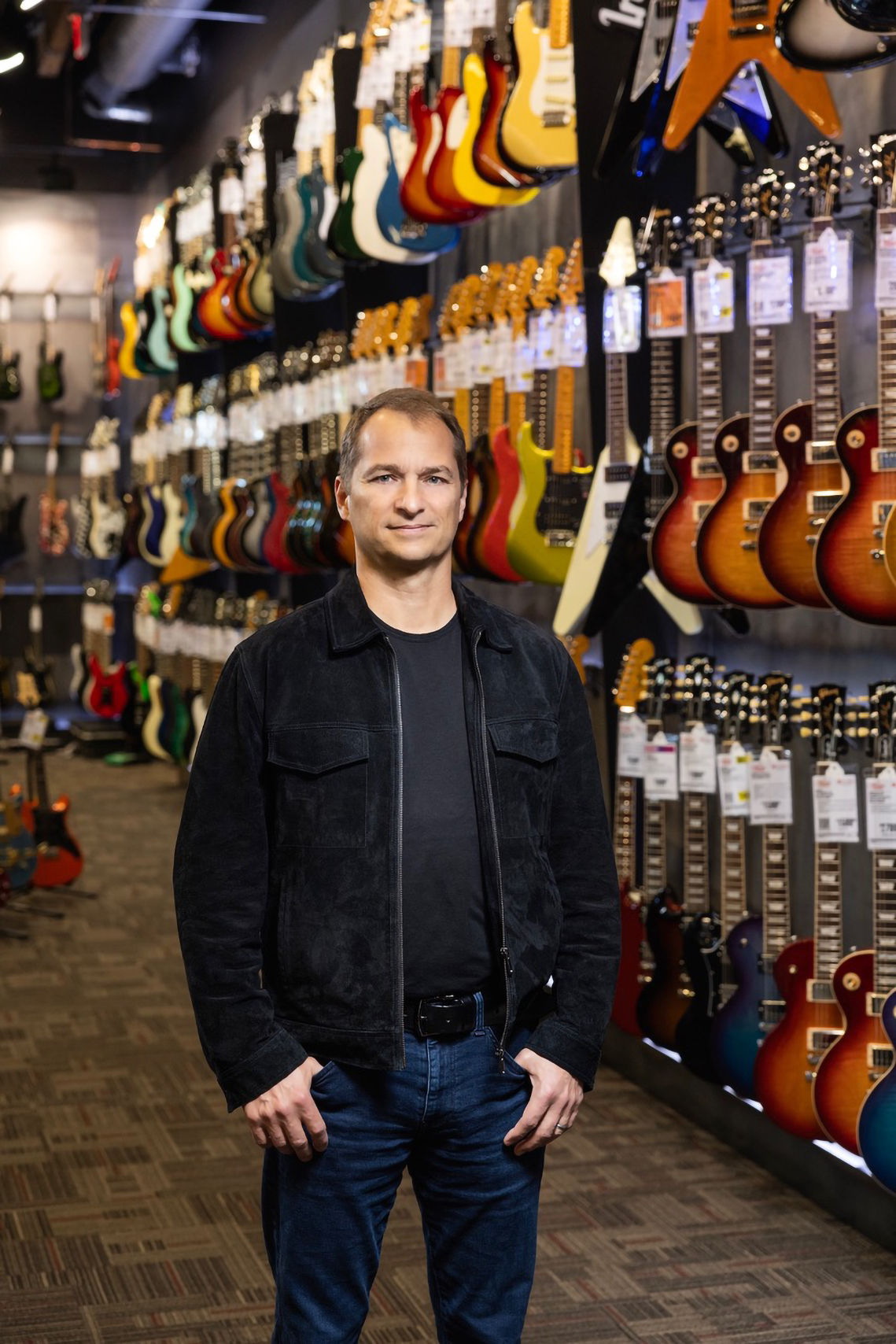
As the MI industry continues to navigate shifting consumer expectations, omnichannel retail, and margin pressure, Guitar Center is making a deliberate bet on artificial intelligence as a lever for both efficiency and differentiation. Under CEO Gabe Dalporto, the nation’s largest musical instrument retailer is exploring how AI can support everything from in-store selling and customer engagement to inventory visibility, associate enablement, and back-of-house operations — all while preserving the hands-on, expertise-driven experience musicians expect.
In this Q&A, Dalporto shares how Guitar Center is approaching AI adoption in practical, business-driven ways, what lessons the company has learned so far, and how intelligent tools can complement — not replace — human connection on the sales floor. His perspective offers a look at how AI may shape the next phase of musical instrument retail, with implications for retailers, manufacturers, and the broader MI ecosystem.
“AI isn’t like another coding language that’s modestly better than the last one. It makes things that were completely impossible, possible.”
What motivated you and GC to invest in AI-powered tools right now?
There have been four major disruptive transformations in my lifetime: the PC, the Internet, the iPhone and AI. AI is going to be bigger than the internet and will happen much faster. We have a simple choice. We can either (1) embrace AI fully and disrupt ourselves, or (2) ignore AI, and someone else will use AI to disrupt our business model and kill us. We choose option 1.
Can you talk specifically about the new Pitch Practice and Rig Advisor platforms? What do these systems do and what are the benefits for customers and GC team members?
They each do slightly different things, but solve the same problem. When I ask customers why they come into a Guitar Center store when they could buy the same things on the internet, they almost always say they need to speak with a deeply knowledgeable expert before making a major purchase. And mostly, that’s what they get. But we’re constantly hiring new people who have varying degrees of product knowledge, and that knowledge is really specialized in one product category or another. So, we wanted to up the bar and make sure every associate in any area of the store will be able to deliver that knowledge.
Pitch Practice is an AI voice agent, which pretends to be a customer. Our associates go through an entire simulated customer engagement, from greeting the customer, drilling into the nuances of what the customer needs, consulting with them on the best possible solutions, and then completing the simulated sale. Afterwards the tool critiques them on their entire end to end interaction, what additional questions they should have asked, maybe alternative product recommendations they should have made. It gives them 2-3 things to work on that day to get better. And it gives them a score. Salespeople are competitive, so they quickly start trying to outdo each other, which incentivizes them to practice more. So, it’s a fun, gamified way to get our associates to enhance their knowledge and customer service skills.
With Rig Advisor we took a different approach. The question was, how do we create a customer centric tool capable of acting like the most knowledgeable music gear advisor to ever walk the earth? Just scan a QR code and it pops up on any mobile device. It’s geo-aware, so it knows exactly what products are available in the store you’re standing in. And you can ask it literally any music and gear related question. “How do I sound like Jimi Hendrix on Purple Haze in 1968?” It will tell you the exact guitar to pick off the wall, the pedals to plug into on our pedal stations, and the right amps. It will even tell you the right settings. “I have $5,000 and need a PA system for my gig this weekend.” It will select the right mixer, the right speakers, cables, mics, etc., that fit your budget. It’s pretty awesome.
One unintended consequence with Rig Advisor is that while we designed it for customers, our sales associates started using it too. Many of them are experts in a specific product category. Say a customer asks a guitar specialist what recording mic they recommend. In the past, they’d have to go find you a tech specialist. Now they can consult Rig Advisor and give highly relevant answers on the spot. It turned out to be a great training tool as well.
How does AI fit into your broader GC business strategy in the next five years?
We’re going to dramatically increase our use of AI to make everything we do better and faster. We already have about a dozen high-value AI tools that are in use at scale already. That’s going to increase by orders of magnitude.
Are these AI initiatives primarily about improving efficiency, enhancing customer experience, or driving new revenue streams?
They are a mixture of customer facing tools like Rig Advisor, associate productivity tools like Pitch Practice (and many more), and back end operational efficiency tools. The latter is what I call “boring AI.” It’s not very sexy but can have a pretty major and positive impact on the speed of your organization and the associated cost structure.
How do you see AI changing the traditional retail experience for musical instruments and gear, which often rely on personal, hands-on interaction?
Right now, we’re experimenting to see how customers interact with tools like Rig Advisor, which we’ll continue to evolve and improve. We’re going to be launching additional retail-oriented experiences as well. We think the lessons area is ripe for disruption as just one example. I also think that AI can bring so much incredible complementary information to your shopping experience in real time.
That said, I don’t think anything will ever truly replace the tangible experience of being in a music store and being able to play the instruments. You can read all the articles, all the user reviews, watch all the YouTube videos and think you’re going to love it, and then you come into the store, play it, and you hate it. That’s because every instrument is deeply personal. It either speaks to you, or it doesn’t
We’re working hard to make every area of the store experiential. And we’re using AI to supplement those experiences with really incredible insights and information.
AI is a hot-button topic across many segments in global culture right now, with a measurable degree of concern — even fear — about potential downsides of the technology: privacy breaches, threats to employment stability, over-reach, and outright unchecked use of power as AI advances, etc. What are your responses to those who approach AI-assisted/driven initiatives with hesitation? How are you addressing concerns that AI could replace certain roles or skills within your workforce?
I see it quite differently. As it relates to our associates, a really significant amount of their time goes to fighting with our antiquated tools or doing a lot of unrewarding things like trying to find a missing guitar case in our warehouse (which is actually shockingly hard). That makes nobody happy. So, we can use AI to make those tasks fast and trivial. Instead of using those recaptured minutes to reduce headcount, we’re letting them spend that extra time serving our customers. That makes much happier customers, and much happier customers tend to spend more money with you. It’s a win all around.
Have you seen any measurable improvements in productivity, sales, or customer engagement already since introducing AI-driven tools?
Yes, meaningfully so. Here’s an example. Nonprofits are allowed to purchase products sales tax free, but the laws are different in all 50 states. The process is incredibly manual, and if you get it wrong, the state sues you. Normally, this process can take a long time, sometimes up to two hours. We’ve used AI to automate the entire process in five initial states, and now it takes only a couple minutes. That’s a game changer, and there are many, many more coming.
What’s been the most surprising insight or outcome from implementing AI so far?
AI isn’t like another coding language that’s modestly better than the last one. It makes things that were completely impossible, possible. If we tried to use traditional coding to build the state tax tool, it would have taken a huge team a very long time to get all the logic nuances correct, and it would be obsolete a year later. With AI, that’s suddenly a solvable problem.
What advice would you give to other MI retailers considering similar AI adoptions?
We welcome the competition.
Anything else you’d like to share with MMR readers on these topics?
If you’re an AI disruptor and a musician, we’re hiring.


