If there’s one corner of the MI business that refuses to clean up its act, it’s distortion and overdrive. From barely-there breakup to full-on sonic mayhem, gain pedals remain the industry’s most reliable way to turn curiosity into a sale—and a player’s polite tone into something far less civilized. For all the innovation in digital rigs and modeling, musicians still can’t resist the simple pleasure of stomping on a box that makes things louder, dirtier, and, somehow, better.
To dig into why dirt still dominates, we gathered insight from seven key voices across the category: Josh Chapman, senior product manager of Accessories at Fender; Andrew Barta, president of Tech 21 USA, Inc.; Kevin Bolembach of Godlyke, Inc. / Totally Wycked Audio (TWA); Mike Matthews, founder and president of Electro-Harmonix; Frank Facciolo, acoustic guitar / electronics merchandiser at Ibanez; Chris O’Hara, guitar product owner at IK Multimedia; Jonni Lightfoot, marketing manager for DOD/Digitech; and Aaron Marino, product manager, Roland Corporation U.S./BOSS North America. Their perspectives reveal a market that’s equal parts legacy and experimentation—where the appetite for great tone is as strong (and as overdriven) as ever.
What model or models of distortion pedal are currently your top sellers, and why do you think those particular pedals resonate most with players right now?
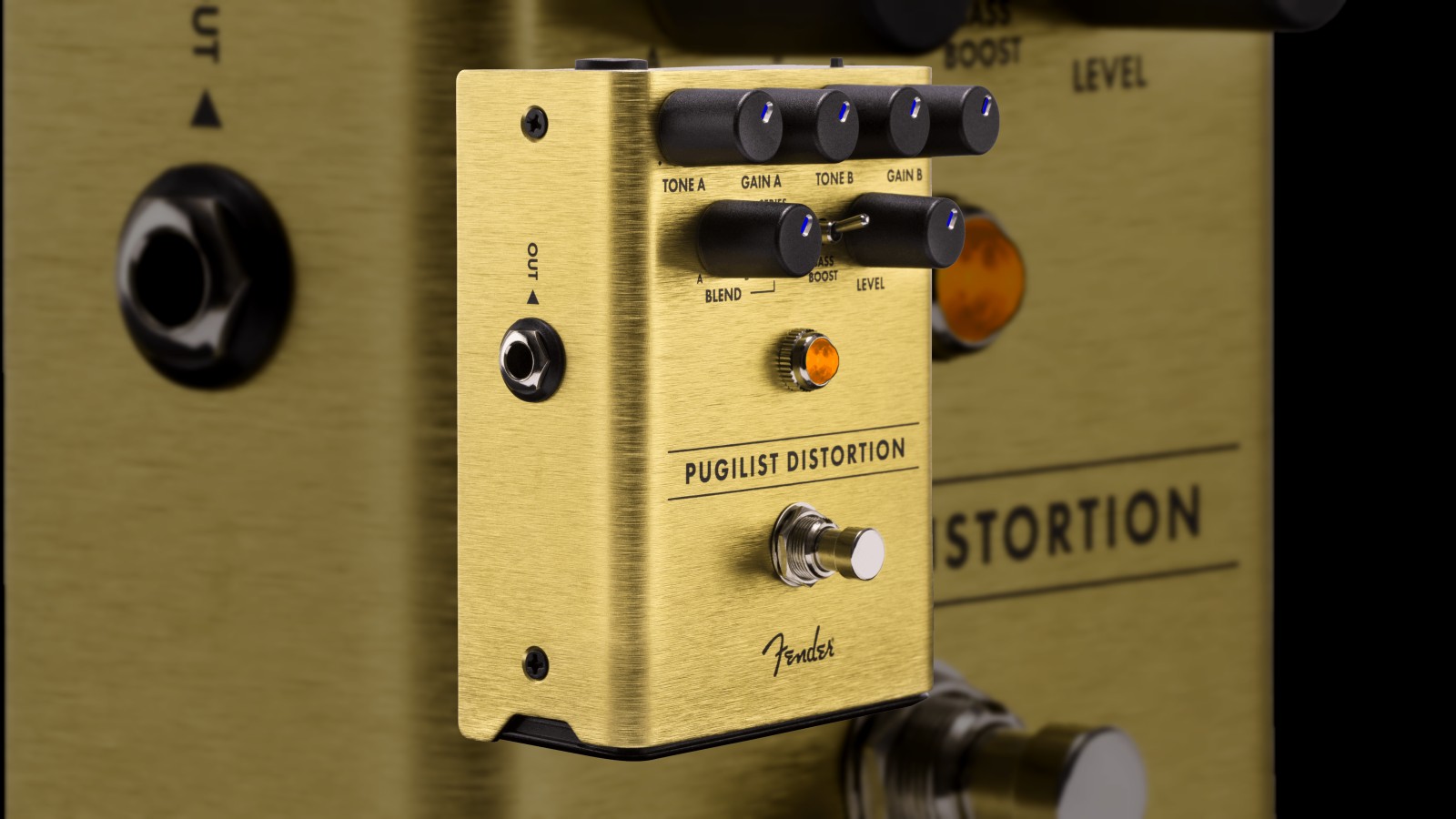
Josh Chapman: The Pugilist Distortion is our top selling pedal in the distortion category, and one dang good sounding distortion pedal. This pedal resonates with players because of its unique circuitry that takes a novel approach on how the user shapes their distortion tone. Rather than utilizing a bunch of switches and knobs to offer minute adjustments within one distortion circuit, the Pugilist pairs two entirely separate distortion circuits into one pedal with the ability to blend the two distortion circuits with each other. This combination of two sparring distortion circuits means that each distortion engine can be dialed in to its strong suites using the most intuitive controls (Volume, Tone, and Gain) and then blended together into one complex distortion tone – providing an expanse of saturated tones that are fun and easy to dial in without getting lost in control paralysis.
Andrew Barta: We stopped making dedicated distortion pedals awhile back. Our focus has been on our SansAmp line of amplifier emulators, which many players actually use for their overdrive and distortion tones such as the GT2 and Bass Driver. Coincidentally, we recently uncovered and released some new old stock of XXLs and CompTortions, and we are about to reissue the Double Drive. All 3 of the original pedals have been commanding high prices in the used market, but it remains to be seen which will be the most popular from these latest releases.
Kevin Bolembach: Currently our top seller is the TWA Source Code. It is our latest release, so that fact is certainly driving its popularity. In addition, it was designed by Susumu Tamura, the engineer who designed the TS808 Tubescreamer as well as dozens of other legendary pedal circuits. Source Code is a modern reimagining of the 808 circuit, which is probably the most copied & cloned pedal in history – I think a lot of players are curious as to how the original engineer has approached improvements to his signature circuit.
Mike Matthews: Big Muffs are our specialty and that shows in our sales. Right now, our NEW Big Muff 2 is hot! It’s out strongest seller at the moment. The Bender Royale is also a fantastic new Bender-style Fuzz that is doing very well. The standard NYC Big Muff Pi (in the big chassis), the Nano Op-Amp Big Muff, and Bass Big Muff are our top 3 established distortions. The Big Muff is one of those classic sounds that keeps enchanting players new and old. With our selection now wider than ever, there’s a Big Muff out there for everyone! If we’re not talking Big Muffs, our top Distortion is the Nano Metal Muff, which has a really powerful EQ, a noise gate, and tons of gain. Everything a high-gain pedal player could want.
Frank Facciolo: For us it’s the Tube Screamer and the most popular model is the TS9. It is arguably the most popular overdrive pedal of all time. It is a classic design that can be used in a verity of situations making it appealing to guitarists of many different genres.
Chris O’Hara: Our top seller is the TONEX Pedal, though it’s probably more accurate to describe it as a platform rather than just a distortion pedal. Our AI Machine Modeling technology captures more than just amp or pedal distortion, but the entire signal chain behind it, including speaker, mic, preamp, EQ, and boost.
What players are responding to right now is access. Instead of choosing a single pedal or one specific flavor of gain, they can pull from thousands of captured tones, including amps, drives, and full rigs, all in one place. That ranges from classic circuits to rare boutique gear and artist-driven sounds. So the appeal goes beyond simply having a great distortion. It’s about no longer being limited to just one. This makes for an extremely creative platform that grows with each player.
Jonni Lightfoot: The Badder Monkey is known as an overdrive pedal, but it’s actually way more than just that. With three different overdrive circuits, you can dial in everything from a light country vibe to a full-on hard rock growl. Once you switch it to “Troop” mode, combining all three circuits, your sound really comes alive! We’ve also got the Overdrive 250 preamp, which has been a bestseller since 1974—it’s what put DOD on the map. We just released the 10th version of the 250, called the 250-X, and it offers three different diode options: Silicon for vintage tone, ASYM for asymmetrical clipping, and Lift for clean or dirty boost without diode clipping. My go-to distortion pedal is the DOD Gunslinger. It’s a MOSFET distortion that gives you that “Marshall in a box” aggressive sound, plus it’s super responsive like an amp. We believe our distortion pedals really connect with musicians because we prioritize excellent sound while keeping them affordable, making them great for beginners and pros alike who might be using them in the studio or on the road.
Aaron Marino: Our top-selling models have remained unchanged for several years, some for decades, with theDS-1 Distortion, SD-1 Super Overdrive, and BD-2 Blues Driver consistently landing in the top ten for us. We feel our pedals continue to resonate with all types of players: those rediscovering a favorite after time away; players inspired by BOSS at the start of their journey who are now returning to us; and those who are brand new to playing. Recently, we’ve also seen an exciting surge in a younger generation discovering BOSS for the first time. We have a significant advantage because our pedals are iconic, ruggedly built, and simply named. If you are a new player looking for distortion, there’s a bright orange box called ‘Distortion’ that has been a staple of stage and studio and found in music stores for nearly 50 years. It’s affordable and requires no deep technical knowledge; you just plug in and go.
The sonic identity of our pedals is up to the player. Because the designs are so fundamental, we aren’t pushing users down a specific stylistic path. It’s a blank canvas that allows every musician to define their sound on their own terms. Many of our pedals, like the DS-1, SD-1, and BD-2, have had the very good fortune of being just that: the sonic choice of many iconic, game-changing artists that used our pedals to forge their own unique musical voice and style.
How have player expectations for distortion pedals changed over the past five to ten years (e.g., gain range, clarity, versatility, MIDI, presets, et cetera)?
AB: I find there are two major camps: those that prefer a vintage sound and feel, and those that are looking for more modern, unusual timbres, soundscapes, even territories of noises, given the popularity of shoegaze. So there’s a wider gamut of overdrives now than ever before.
MM: There’s an interesting trend towards both more natural sounding, preamp style drives that respond like amps and (in the opposite direction), more lo-fi offerings that have their own unique behaviors that fly in the face of what traditional “good tone” might be. We’ve just built the Bender Royale which is a Tone Bender style-fuzz with a load of options, including a Bias knob which bring in a host of interesting textures you wouldn’t normally get on your standard 2 or 3 knob fuzz. The sounds can be challenging to play traditionally and encourage players to try something new.
AM: Expectations have evolved, and many players now require more from their gear, specifically MIDI integration, presets, and expanded EQ. To meet the demands of modern setups that use loop and MIDI switchers, we developed pedal lines, such as the BOSS 500 Series and BOSS 200 Series Pedals. To solve the need for a more versatile drive, we created the BOSS OD-200 Hybrid Drive, a hybrid analog/digital pedal featuring extended gain ranges, presets, wide EQ control, dual footswitches, full MIDI capability, and more. This unit can even combine two types of its overdrive and/or distortion tones in series or parallel for those who like to stack their drive tones. A very versatile pedal for any pedalboard. Other solutions we offer have emerged from the needs created by new musical genres and the needs of musicians in these styles. For example, much of today’s modern metal utilizes lower-tuned guitars with high gain and intricate, beautifully dissonant chords. Sometimes combining the two elements is a challenge. As a solution, we offer our BOSS X-Series pedals, such as the DS-1X and OD-1X, which deliver high-gain saturation while maintaining exceptional note clarity—even during complex chord voicings. This is achieved through our proprietary Multi-Dimensional Processing (MDP), an advanced form of multi-band technology that intelligently adapts to your playing in real time.
Having been in the pedal business for decades, we’ve seen trends come, go, and come back again. Whether it’s the genre, the generation, or the individual player, we often see gear start out simple before evolving into increasingly complex rigs, only to eventually experience a rebirth where the player returns to simpler needs and solutions.
Because we strive to be that solution, we offer diverse lines of pedals. From complex MIDI rigs for touring players on synchronized stages to those returning to their favorite BOSS pedal because they miss the purity of a simpler setup, we strive to design all our gear to deliver incredible sound and solve the specific needs of every musician.
KB: I don’t know about the rest of the market, but our customers seem to be fairly traditional and are not looking for presets, MIDI, etc. Our customers seem to be more interested in sound and build quality over the implementation of current technologies into circuit design.
FF: It’s a mixed bag. That’s how we end up with so many different kinds of pedals in the market. There really is something for everyone out there. There has been more interest in newer DSP technology and higher gain but at the same time the classics remain the classics for a reason and continue to collectively dominate the market.
CO: Players still want great amp tones, but their expectations have expanded well beyond the pedal itself. Today, it’s really about flexibility and workflow. Guitarists want to move seamlessly between home, studio, and stage setups without having to rebuild their sound each time. They also want access to more tones without adding more gear. That’s where capture-based technology has made a big impact. With TONEX, players can bring their favorite amp or pedal tones with them by capturing their own gear or accessing the ToneNET library, and then use those sounds consistently across hardware and software. So the expectation has shifted from a single pedal doing one job to having your entire tone available wherever you play.
JL: I don’t think expectations have really changed much. Players are always looking for something that sparks their creativity, and at any moment, they might want to switch from a fuzzy tone to an overdriven sound or something heavier. That’s why distortion pedals are one of the most commonly swapped-out pedals on a guitarist’s board. Some musicians even like to use a bunch of distortion pedals at once, which they call “stacking.” Versatility is definitely a big deal for guitarist.
JC: Over the years, player’s expectations for flexibility and versatility have become on par with their expectation for great tones. In days of their inception, distortion pedals existing in their own right broke the mold and were praised for inventive sounds – comments like “limited range” or “one trick pony” where not really seen as an issue. Now a modern production pedal is expected to offer a sweeping range within its target tonal pallet. This versatility for distortion pedals can come in the form of wide-ranging controls, extended control options, signal path or mode switching, and even MIDI and preset functions. At present, MIDI and preset functionality still seem to be more in demand in time-based and modulation effect pedals; where-as versatility for players in distortion and gain circuits seem to be more focused on the flexibility of the control set on the pedal and each control’s impact on their ability to carve out a very specific tone.
Where are you seeing the strongest demand today—classic analog distortion circuits, modern high-gain designs, multi-mode pedals, or something else?
AM: We still see the strongest demand for our classic pedals like the DS-1 Distortion, thanks in part to a long history and presence on countless legendary records. While the market is filled with endless drive variations and new ideas, it is such a vast space that it’s often difficult to pinpoint strength in one area over another. For us, time and time again, our analog, three-knob designs stand out in this very crowded field.
For sure, we have seen a rise in demand for ‘Amp-in-a-Box’ style pedals like our IR-2 and IR-200 Amp & Cabinet pedals. While these amp-modeling effects are increasingly popular, much of that sound relies on replicating foundational amp tone and gain. Players often push that sound into higher levels of saturation by gain-staging other pedals into the mix, typically an SD-1 type overdrive or our new Waza Craft BP-1W Booster/Preamp, to add that final layer of character and responsiveness.
KB: We only manufacture analog circuits, so I wouldn’t know what the demand is for digital, multi-effects, etc. We have always seen a strong demand for 808-style overdrive circuits, and since we are partnered with the creator of that circuit, that’s where we’ve been placing our focus for the past several years.
CO: We’re seeing demand shift away from specific types of distortion and more toward authentic, accessible collections of tone. Players aren’t just asking for a high-gain pedal or a classic overdrive anymore. They’re looking for the exact tones used on records, access to rare or hard-to-find gear, and sounds that are already dialed in and ready to sit in a mix. That’s why ecosystems are becoming increasingly important. Through TONEX, players can explore ToneNET, Signature Collections, and Tone Partner content, which all go far beyond what a single pedal can offer. The real growth isn’t happening in one category of distortion. It’s in having all of them available instantly.
JL: I think there’s space for all of it. I get why some people stick to analog circuits, and I totally see the appeal of using multi-effects or modelers too. They all have their place. Personally, I mix things up depending on the gig—whether it’s a fly-date or just playing at the local bar. Ultimately, it’s all about what fits your style and what you need!
FF: Our brand’s success comes from classic analog circuitry and we continue to lean into that even with our new designs.
JC: In our product line, The Pugilist Distortions checks both the classic analog and high gain distortion boxes. We are also seeing an increased interest and adoption in our digitally modeled distortion effects – especially within our Tone Master Pro. The labor of love that goes into part-for-part modeling within our digital signal processing is definitely being appreciated as we see more and more praise and demand for additional distortion pedals within our Tone Master ecosystem.
MM: Classic analog is still in high demand. The analog circuits with the longest staying power are usually the pedals with the highest demand. You don’t get more analog than the Big Muff and that’s certainly our strongest player on the field.
AB: Our passion is vintage analog, so that’s the market we attract, which has always been consistently strong. The market tends to get easily distracted by shiny new objects, as I like to call them, but eventually they circle back because their satisfaction level wanes. Anything considered the “strongest demand” today can be gone in an instant. So we tend not to be influenced by the flavor of the day.
What design elements do you prioritize when developing a new distortion pedal to help it stand out in a crowded market?
MM: Soft latching and momentary footswitches and more versatile EQ options. If it’s a high-gain distortion or fuzz, then an internal gate. If it works great on bass then we’ll add a Blend control to retain the low end of the bass’s dry signal making. Then it’s useful for both guitar and bass players. Maybe a secondary clean boost so you can go from always on distortion to solo boost all on the same pedal.
JL: Versatility, personality, overall vibe of the pedal, and not to take ourselves to seriously… if you question that last one then have a listen to the DOD Buzz Box pedal. Many pedal manufactures approach design with a completely utilitarian approach to their designs. We like to have fun with everything from design, to marketing Easter eggs, and what’s included in the box. We are very aware that pedals become an extension of a players personality so having fun with it extends to the players as well. After all it is the music business
CO: With TONEX, it’s really about how the hardware fits into the larger ecosystem. We focus a lot on immediacy. Players need to be able to plug in, find a tone quickly, and switch between sounds without slowing down. That means intuitive controls and a smooth, reliable experience in real-world use. Integration is just as important. The hardware has to work seamlessly with TONEX software and ToneNET, so tones can move easily between pedal, plugin, and mobile. Consistency is another big piece. A tone should feel the same no matter where you’re using it. At the end of the day, the goal is to make the hardware a simple, reliable way to access the full TONEX ecosystem.
AB: As always, the goal is to find a new angle. With the XXL, you can adjust odd and even harmonics with a single pot. The CompTortion combines compression and distortion in a musical fashion. The Double Drive has a cascading effect with one feeding into the other. For me, there’s no point of making yet another screaming green pedal. The original is usually always the best and endures. When you copy, you lose. When you innovate, you win. The innovation can be minor, but it has to be something new, not just the same old sausage!
JC: As with any of our products, tone is our first priority. Ensuring that the pedal can generate musical, inspiring tones that add to a player’s instrument in a meaningful way is always the starting point. This principle tends to drive the initial circuit direction when it comes to the circuit topography and component selection (transistor or op-amp based, diode selection, et cetera). Providing quality tones that we can stand by is really the core of justifying a pedal’s placement on anyone’s pedal board, and we take it very seriously.
But placing a great tone inside of a box is half the battle, ensuring that a pedal is easy to use is just as important. Our goal is to design products so that players can intuitively access the great tones we pack inside of the enclosure without barriers to entry. This part, the control selection, is where a lot of our testing and development energy is spent. How the player interacts with the circuit is crucial not just to how the pedal stands out, but to how it can really have an impact on a player’s sound. We take user experience as a very serious tenant and we focus a lot on finding innovative ways for players to engage with their tone – whether that comes in the form of meticulously dialing in the range of a single control knob so the user has all the best settings with no extra fluff, or implementing new kinds of controls that provide an exciting way for players to unlock new sounds (like the Pugilist’s blend control). In the world of pedals, the effort you put into defining your user interface and the selection of circuit touch points you provide to the player are the way you really define your place in the market.
FF: First and foremost we are always focused on quality. The majority of our pedals are still manufactured in Japan by a small team of skilled people using high quality components. For new designs we always look to pack in a feature set that will provide the player more versatility than they may find in other similar pedals.
KB: When we designed the TWA Source Code, we were looking at 40+ years of opinions on what people liked & didn’t like about the Tubescreamer circuit. That information was then filtered down into a short list of upgrades that would yield the most beneficial results without straying too far away from the mojo of the original circuit.
Some of these features – such as the multi-transistor input buffer and the 18V operation – were selected to correct shortcomings in the original design. In the case of the two features listed above, they were implemented to reduce unwanted distortion of the input signal & reproduce the incoming guitar signal more accurately.
Other new features were included because they were novel and offered tonal options that were not available from the original circuit. These would include the use of a special op-amp which generates additional harmonic content as well as the Bite control, which allows the user to dial in the amount of even-order harmonics present in the output signal.
AM: At BOSS, we are always searching for the new, the unique, and the different. While a lofty goal, it is a tenet that drives us, even when the path is challenging. To that point, it has been some time since our last entirely ‘new’ analog drive pedal in the standard compact range, the MD-2 in 2001. In the years since, we have shifted our focus toward meaningful collaborations, such as the JB-2 Angry Driver with JHS and the TB-2W Tone Bender with Macari’s. Additionally, our Waza Craft Series offers evolved takes on our most popular designs; models like the DS-1W, BD-2W, SD-1W, and MT-2W provide both the original classic sound and a modern ‘modded’ version in a single unit. We also introduced the HM-2W, which bridges a faithful reissue with a modern mode, and the BP-1W, which recreates the elusive preamp magic of the RE-201 and CE-1. Our iconic legacy has proven to be the perfect foundation for bringing these legendary, hard-to-reach sounds to modern pedalboards.
Are you seeing differences in what retailers want versus what players request directly (for example: price points, feature sets, form factor, or aesthetics)?
JL: At DOD/DigiTech, we really pay attention to what players want and what our engineers come up with. Take the Badder Monkey, for example—people have been asking for a remake forever, and we finally made it happen! But instead of just giving it a straightforward “reissue,” we wanted to take it up a notch. We kept the original Bad Monkey circuit but threw in two newer circuits to make it even better. So you get that classic vibe with some cool upgrades! We aim to create pedals that keep us ahead in the music game, but we also love experimenting with new ideas. The DigiTech HammerOn is a perfect example of that. It wasn’t something anyone specifically asked for and BTW neither was the Whammy, it was just an idea from our engineers. Pitch shifting isn’t new, but the SEQ mode with Trill definitely is. This feature lets you set 2, 3, or 5-note sequences, and you can make those notes whatever you want within a 2-octave range. It can produce sounds that are downright impossible to play, inspiring new riffs and hooks you’ve never heard before. More artists that are in the studio are requesting the HammerOn, so soon enough, it’ll be popping up in lots of recordings!
AM: Not really. Retailers naturally stock what musicians want to buy, so their inventories tend to reflect what sells. These days, with such a vast range of pedals available at every price point, it’s difficult to pinpoint a single trend; however, we know that demand for our classics like the DS-1 never lets up. Our take is that players expect a pedal to sound good and be built to last, and we think we have delivered that for nearly five decades. We were fortunate to nail so many design benchmarks early on, features we haven’t needed to change, such as the recessed knobs to prevent accidental setting shifts, isolated battery compartments to protect circuit boards from leakage, standardized 9V power, and buffered bypass with silent FET switching designed to withstand thousands of presses.
CO: There’s still a difference, but it’s definitely getting smaller. Players tend to focus on flexibility, tone quality, and ease of use, while retailers are looking for products that are easy to demonstrate and clearly communicate value. What really bridges that gap is immediacy. When a player plugs into something like TONEX and quickly finds a tone that feels right, whether it comes from ToneNET or a curated collection, the product becomes much easier to understand and sell. A big part of our focus has been simplifying access to what is actually a very deep ecosystem.
FF: I think in the end it all comes down to the consumers. If you can provide them a compelling product at the right price point it’s a win all around.
KB: Not particularly. I would think that retailers base their purchasing decisions largely on what’s trending in the market, so assuming that what’s trending is what players are looking for, then there should be synergy between the two.
JC: There seems to be general alignment between the retailer and player needs in the pedal market. For the most part the requests of both parties seem to line up pretty directly, and we haven’t had much conflicting feedback from the two.
AB: From day one, our customers have given us constant feedback, mostly about features and form factor. We actually review and consider all suggestions. Dealers, for obvious reasons, tend to be more focused on price points, honestly, and rarely offer design input. Our international distributors do chime in on occasion to request special edition colors or specialized graphics for certain artists popular in their country.
MM: Dealers have always been looking for a product they can move, which is usually something that stands out just enough from the rest of the market while maintaining a good price and margin. Players on the other hand also want good price points but want increasingly specialized features which would be exceptionally difficult to work into units that have mass appeal. Finding the sweet spot is our main challenge as a pedal maker.
Looking ahead, what trends or innovations do you expect to shape the next generation of distortion pedals?
AB: Digital is obviously going to play a greater role in it. There’s more freedom to create a range of new sonic environments you can recall within a small footprint. However, what most people don’t realize is that it’s not solely about any particular distortion pedal. It doesn’t create an appealing sound on its own without an amp or amp emulator. You have to also understand the chemistry of the combination. For instance, Jimi Hendrix used the Fuzz Face with a Marshall. You couldn’t get his sound without using both. That was my inspiration for the Character Plus Series of SansAmps.
KB: I think there will always be companies that are implementing the latest technology into their products. That being said, I am certain that some AI-powered pedals are currently on the drawing boards at several companies. At the same time, there still seems to be a very healthy interest and respect for the classic circuits that have been essential in defining the sound of rock guitar for the past 60+ years. Hopefully these two extremes can continue to co-exist as well as merge at certain nexus points as well.
MM: Making digital distortions that feel as good as analog while creating unique sounds that are hard to obtain with analog.
JC: As circuit designs improve across the board in both noise performance and space saving with smaller components, we expect to see players demand an even higher standard of performance in tone and versatility from their distortion pedals. The ever-present dream of players wanting to get as many tones out of one pedal as possible will likely push the boundaries of analog pedals further into MIDI and digital control of analog circuits – both to enable presets and to open new routing options and circuit control not possible without digital switching. Beyond that, as the adoption of digital modeling grows in the market it is likely that in the coming years we will start to see digital modeling technology perforate more into the drive and distortion categories than we have seen in the past.
FF: I think you will continue to see additional functionality built into circuits to give the player added value.
CO: We’re seeing capture-based ecosystems becoming more standard rather than niche. Tone libraries are evolving into content, with artists, brands, and creators releasing their own sounds. Hardware is getting smaller while capabilities continue to grow, often connected to large libraries. Cloud integration is also becoming more important, allowing players to browse, share, and update tones in real time. At the same time, hybrid rigs are on the rise, with players combining digital tone platforms and select analog gear. So the future of pedals isn’t really about pedals alone. It’s about giving players full access to the tones they want in whatever format fits their rig.
AM: At our heart, the BOSS team is comprised of guitar-playing pedal and technology geeks, so we are always inspired by innovation. We are closely watching the emergence of AI technology in the music world. While it’s a new frontier, we see it as another powerful tool for creators to push the limits of their imagination. We also feel a real sense of kinship with the many other pedal brands in the market today. Many are taking classic circuits and adding their own unique twists, raising the bar for what a gain pedal can achieve. Though more features can often lead to higher price points, this evolution mirrors the music itself. With such a vast diversity of tones and music genres available to listeners today, the need for unique gain tones will only continue to expand, and we’re excited to be part of that journey.
JL: Thanks to the cool new features and success of the Badder Monkey, we have definitely caused a stir in the distortion pedal market. With our cool new Patent-Pending Barrel control, I wouldn’t be surprised to see other brands trying out the idea of multiple independent distortions all in one pedal, letting you mix and match them in different ways. They might even borrow from our “Troop” mode, which combines all three circuits into one sound. Additionally, let’s not forget the StagePlate™. This simple yet effective idea securely attaches your pedal to the pedalboard, keeping them clean and free of tape and Velcro residue.