Dept: Upfront Q&A
by Christian Wissmuller
PQ: “Today’s customer is highly informed and often prefers to explore independently before engaging with a sales associate. We wanted to empower that behavior, not interrupt it.”
++++++++++++++++++++++++++++++
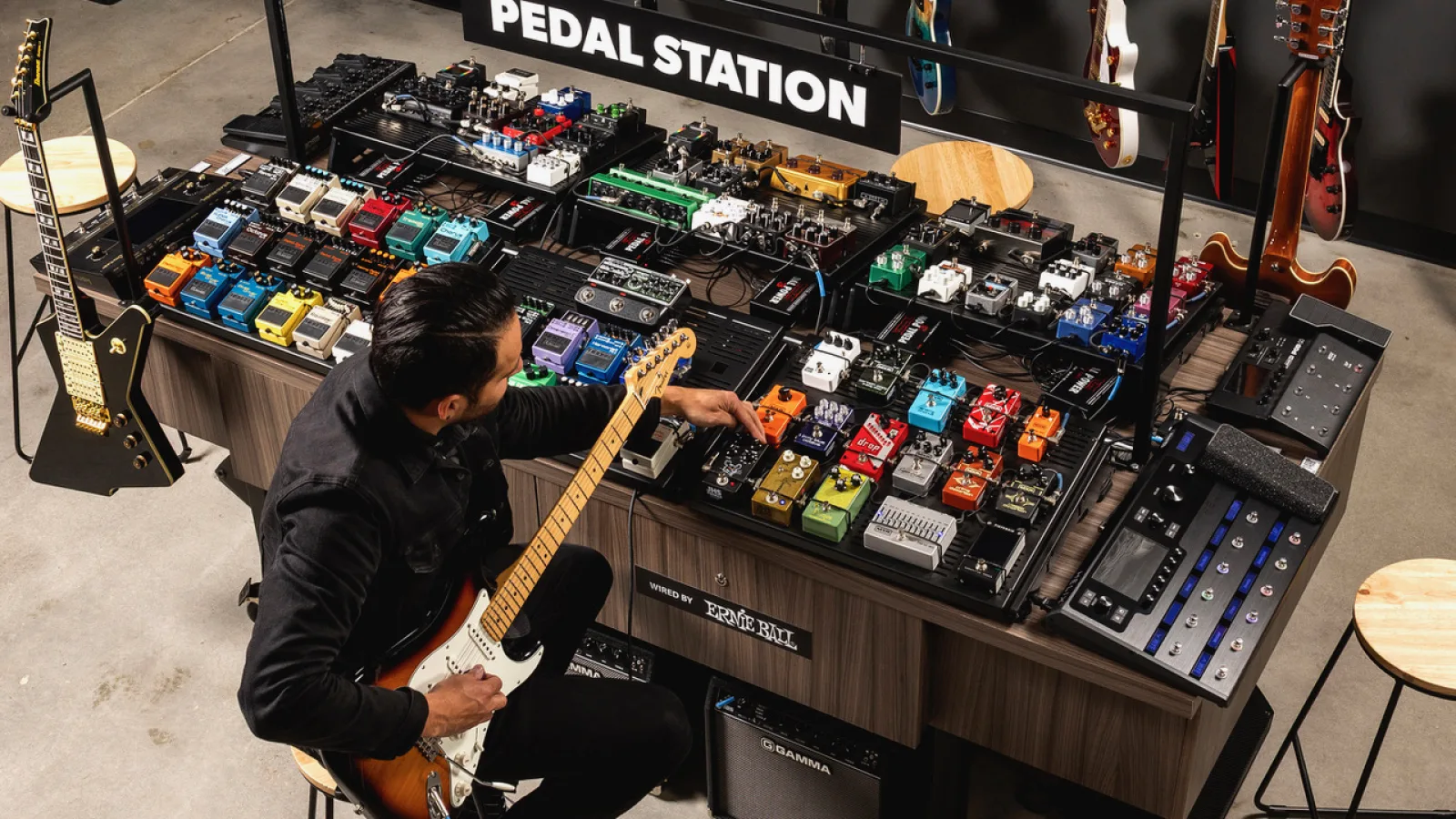
As brick-and-mortar MI retailers continue to navigate shifting consumer expectations, experiential retail has moved from a differentiator to a necessity. Guitar Center’s new in-store “Pedal Island” —an interactive, plug-and-play effects playground—represents a notable investment in hands-on discovery, streamlined merchandising, and category growth. MMR spoke with company leadership about the goals behind the concept, early results, and what lessons dealers of all sizes can take from this approach to driving engagement and sales on the showroom floor.
What core retail challenge was Guitar Center aiming to solve with the rollout of the Pedal Station, and how does it fit into your larger in-store experience strategy?
At its core, we were solving for friction in one of the most complex categories in music retail. Effects pedals are experiential — players don’t buy them based on specs, they buy them based on feel and sound. Historically, we locked these pedals up behind glass and customers couldn’t access them, and had to track down an associate and beg them to set one up. Then do it again for the next. And so on. A hugely terrible customer and associate experience. Personally, as a customer before I joined Guitar Center, it was one of my biggest annoyances.
The Pedal Station removes that friction entirely. It turns a fragmented, one-at-a-time trial process into an intuitive, immediate, and immersive experience. Strategically, it’s a clear expression of where physical retail wins. We are leaning into experience as a differentiator — creating an environment where customers can explore, experiment and discover in ways that simply aren’t replicable online.
The Pedal Station leans heavily into self-guided discovery. How intentional was that shift, and what impact are you seeing on customer engagement and time-on-floor?
That shift was very intentional. Today’s customer is highly informed and often prefers to explore independently before engaging with a sales associate. We wanted to empower that behavior, not interrupt it. What we’ve seen is a meaningful increase in engagement. Customers spend more time in the category, they interact with more products, and they move from passive browsing to active experimentation. That matters because time-on-floor directly correlates with conversion and basket size.
And while we made several experiential improvements at the same time as the pedal tables, aggregate time in store increased materially and so did sales.
From a merchandising standpoint, how are you measuring success for the category within the station — sell-through, attachment rates, or overall category lift?
We look at this holistically. Sell-through is important, but it’s only one piece of the equation. We’re equally focused on category lift, attachment rates, and the overall basket growth. In the 8 weeks following the Pedal Station rollout, Effects Pedals experienced a sales increase of +18%.
Pedals rarely exist in isolation — what we’re really measuring is how effectively the station drives ecosystem purchases. We also look at engagement metrics — how long customers are interacting with the station and how many products they’re trying. The data consistently shows that when engagement increases, so does conversion.
The ability to directly compare products — from legacy stompboxes to newer platforms like IK Multimedia Tonex — is central to the concept. How has that influenced purchasing behavior versus traditional “try one at a time” setups?
In a traditional setup, customers tend to default to what they already know, the popular brands or what’s recommended. In a comparison-driven environment, they make decisions based on experience. That leads to more confident purchases and, importantly, more discovery across brands and price tiers. We’re seeing customers trade both up and across — sometimes choosing higher-end solutions because they can clearly hear the value, and other times discovering alternatives they wouldn’t have considered.
For smaller and mid-sized MI retailers, full-scale installations may not be feasible. What elements of the Pedal Station model do you believe are most adaptable at a lower cost or smaller footprint?
At its heart, the Pedal Station is about reducing friction and enabling immediate trial. Even a small retailer can achieve that with a curated selection and simple signal chain. You don’t need a large footprint to create a compelling experience. You just need intentional design.
How do you balance the efficiency of a “plug-and-play” environment with the value of knowledgeable sales staff, particularly in a category where education often drives the sale?
We feel both strategies can coexist and actually support one another. The Pedal Station allows the customer to begin the journey independently. Our associates then step in at the right moment to deepen the experience — whether that’s explaining signal chains, dialing in tone or helping the customer translate what they’re hearing into a purchase decision.
What we’ve effectively done is elevate the role of the associate. Instead of facilitating access, they’re adding expertise and insight. That’s a much higher-value interaction.
And I want to mention one other supplement to the pedal table: Rig Advisor, which is our AI driven gear advisor. There’s a QR at each pedal station to access it, and when you ask it how to sound like Jimmy Hendrix on Purple Haze, it knows the pedals available right in the store and will tell you which ones to try and even what settings to dial the tone in perfectly.
Have you seen measurable halo effects on adjacent categories (amps, accessories, or even guitar sales) driven by increased experimentation within the station?
Absolutely. Two months after the Pedal Station rollout, overall store performance for the Effects category experienced a +11% sales lift. Additionally, Guitar Accessories were +7% and Guitar Amps +3%, demonstrating an overall halo effect for the larger store.
Looking ahead, do you view immersive, modular displays like the Pedal Station as a long-term shift in MI retail, and what advice would you offer dealers evaluating similar experiential investments?
This is absolutely a long-term shift. The future of physical retail — especially in MI — is not about inventory density. It’s about experience density. Customers can access product anywhere. What they can’t access everywhere is meaningful, hands-on engagement.
My advice is to start with the customer journey. Identify where friction exists, where uncertainty is highest and where experience can unlock confidence. Be deliberate with your strategies and what you build. The retailers who win will be the ones who create environments that inspire exploration, not just facilitate transactions.