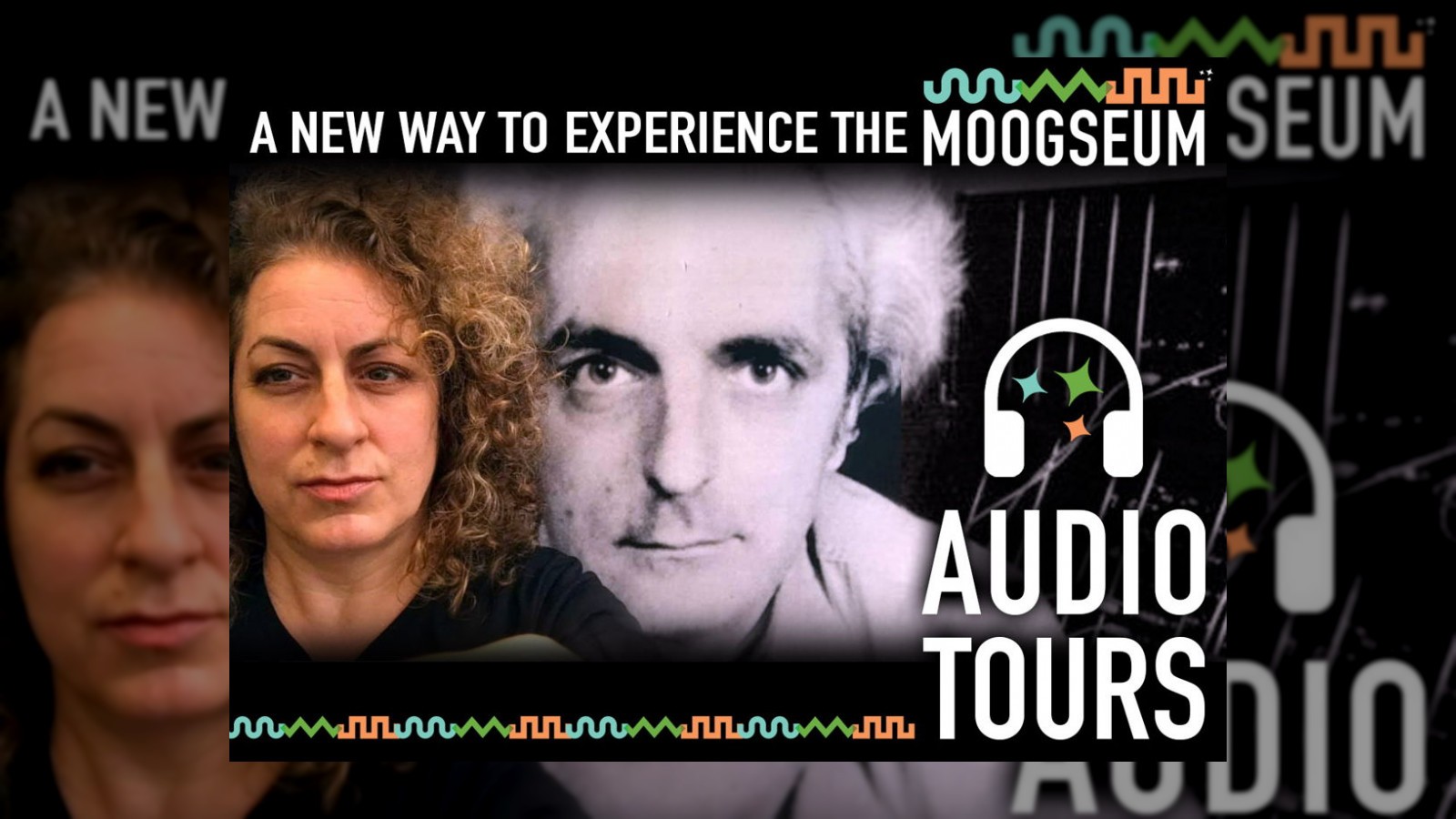
The Moogseum is now offering visitors an additional layer of exhibit content in the form of audio tours. The supplemental narration by Michelle Moog-Koussa, executive director of the Bob Moog Foundation, is designed to accompany existing Moogseum exhibits and provide deeper context for the information they present.
The audio tour is available for $4 with each ticket purchase. The narration is accessed using a smartphone. Guests are invited to either bring their own earbuds or use the Moogseum’s noise-canceling headphones.
The self-guided tours at the Moogseum typically take visitors one hour to complete. The total narration lasts approximately 30 minutes, so visitors are invited to re-enter the Moogseum to explore the interactive exhibits. Visitors can also pause the audio tour as desired to interact with any exhibit while exploring.
“There’s so much information tucked into all of the Moogseum’s one-of-a-kind exhibits,” said Michelle Moog-Koussa. “It’s exciting to be able to lend insights and details that a visitor may not typically glean from the exhibits alone. Every piece of information helps give a greater understanding of the depth and breadth of the Moog legacy.”
Exhibits featured in the audio tour are the Bob Moog Timeline, a detailed account of Bob’s life and career; the Leon Theremin exhibit, exploring the history of the famed hands-free instrument and its inventor; Patching Sound, an exhibit focusing on modular, patchable synthesizers; Bob’s Connection to Asheville, where he spent the last 25 years of his life; the Timeline of Synthesis, exploring a variety of synthesizers from varying manufacturers; Bob’s Workbench, a recreation of Bob Moog’s actual work area; and Hands-On Synthesis, a collection of playable synthesizers.
The Moogseum, first opened on May 23, 2019, is located on 56 Broadway Street in Asheville, N.C. It hosts a variety of interactive, one-of-a-kind exhibits and is open from 11 a.m. to 5 p.m. ET daily. Tickets for admission are $11.75 per person, with children under 7 admitted free of charge.
The facility celebrates the extraordinary legacy of synthesizer pioneer Robert Moog, whose invention of the Moog synthesizer in 1964 helped revolutionize the face of music. It also brings to light many of Bob’s contemporary synthesizer pioneers, musicians who used Moog instruments, as well as teaching visitors about the science of sound and synthesis, all in a highly accessible setting.
For more information on the Moogseum, visit moogfoundation.org/projects/the-moogseum/.
For more information, visit moogseum.org.