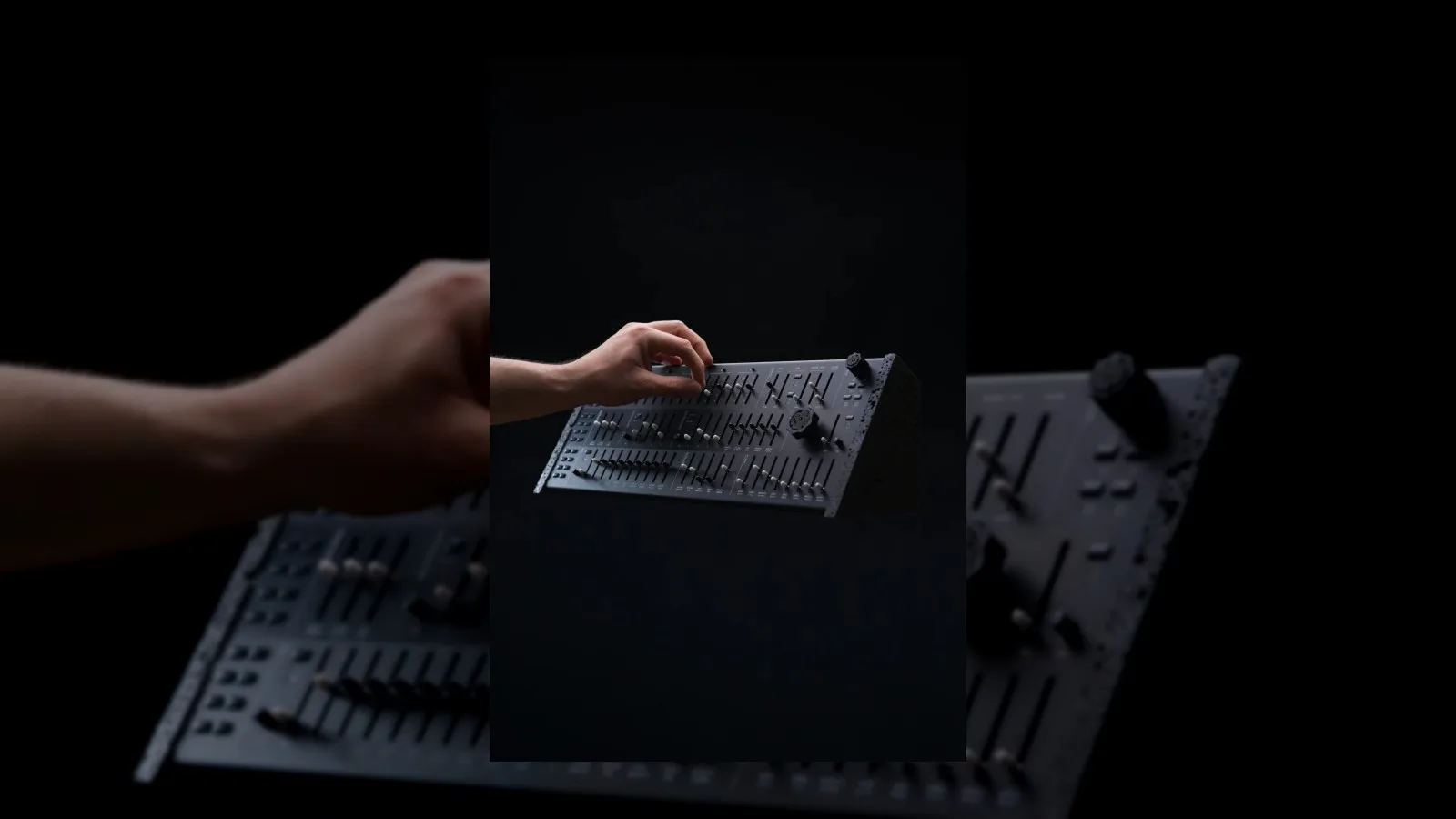
Having twice blown European musical minds thanks to show-stealing showcases at SUPERBOOTH25, May 8-10, Berlin, Germany and Machina Bristronica 2025, September 27-28, Bristol, UK, before adventuring across the pond for a repeat performance at Buchla & Friends 2026, January 24-25, LA, CA, USA, Reykjavik-based instrument developer Genki Instruments is proud to announce availability of the eagerly-awaited Katla as a Voice Rotating Polyphonic Synthesizer inspired by Iceland’s largest subglacial volcano as its natural namesake — readily representing the company’s first foray into analogue synthesis, albeit one that uniquely utilises a set of wildcard parameters to infuse it with organic, unpredictable behaviour as an instrument that is worthy of that legacy, excelling at generating rich, evolving, multi-layered textures, where each note stirs, swells, and erupts in its own distinct way — as of March 31…
Clearly Katla’s inspiration runs through its ‘volcanic’ veins. After all, it is framed by side panels and knobs forged from authentic Icelandic lava, giving each instrument a tangible connection to the volcanic forces that inspired it. That this synth should surely roar is a given. Genki Instruments inevitably chose, therefore, to kit Katla out with four independent distortion destinations, the most unruly of which is a stereo CMOS (Complementary Metal Oxide Semiconductor) Drive effect — a characterful saturation stage, pushing tones from warm and rounded to fractured and snarling.
Active at the core of the Katla Voice Rotating Polyphonic Synthesizer — to give it its full appellation — is its voice-rotating engine that routes notes across five discrete voices, each with individually adjustable parameters. Put it this way: with six unique voice allocation modes, Katla excels at generating rich, evolving, multi-layered textures. The VOICES MODE features three round-robin modes (with each note being assigned to one of the five voices in sequence, creating a rotating pattern of sound) — the first cycles forward through the voices, the second cycles backwards, and the third selects voices at random — alongside three unison modes (with all active voices automatically assigned to the notes played and dynamically adjusted according to how many keys are held): Staccato, whereby envelopes re-trigger with every note trigger; Legato, whereby envelopes re-trigger only when all keys have been released; and Mono Mode, disabling polyphony and allocating all voices to the same note.
Needless to say, Genki Instruments’ first foray into analogue synthesis stands out from the sound of the analogue crowd courtesy of a set of wildcard KATLA parameters.
For more information, visit genkiinstruments.com.