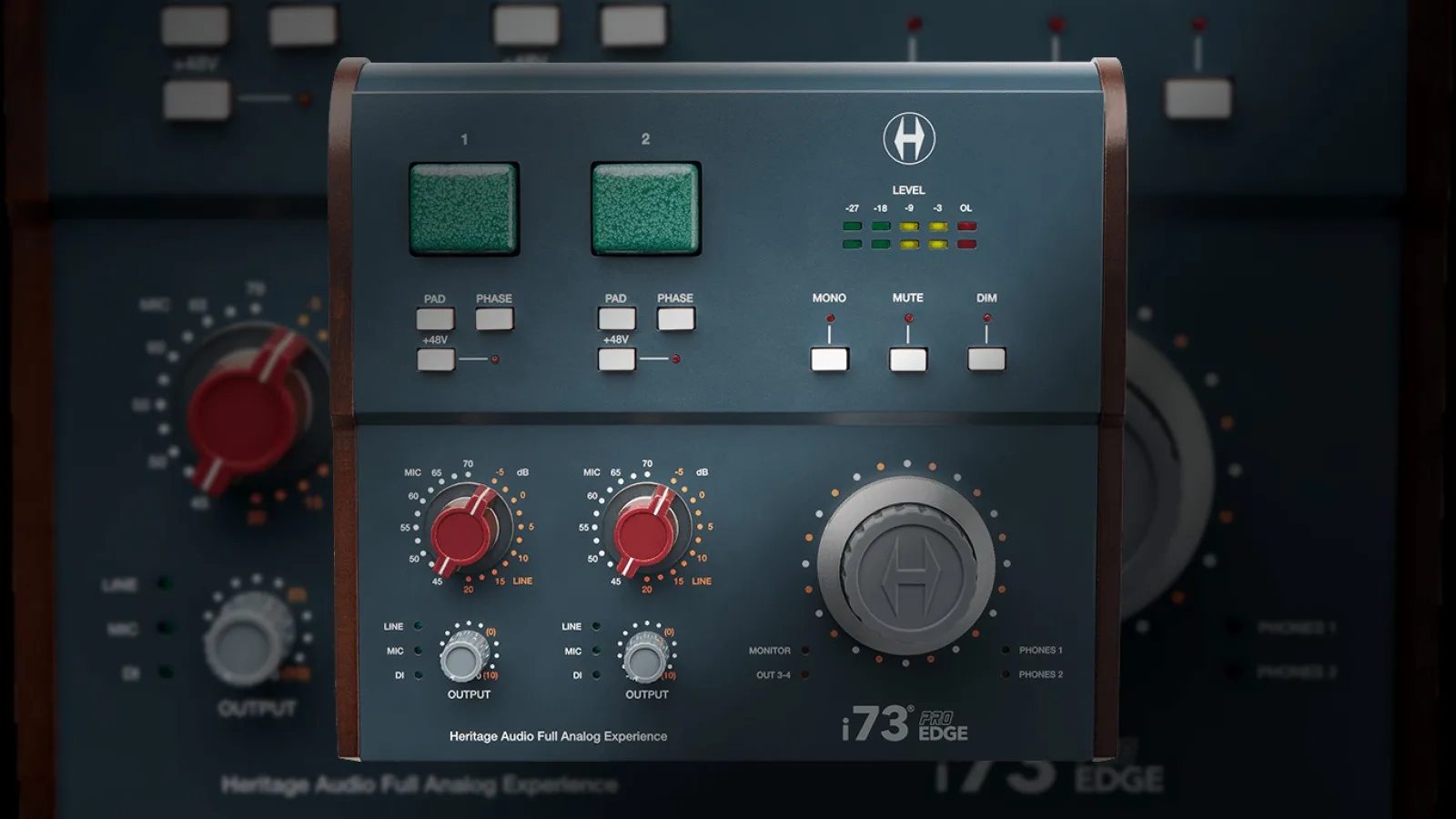
Heritage Audio is proud to announce availability of 73 JR, readily recreating its namesake 73-style mic preamp in a 500 Series single-slot design that effectively started it all for the vintage-sounding recording equipment developer around 15 years ago — and subsequently became something of an industry standard adopted by the majority of professional recording studios worldwide, with many considering it to be the absolute best at capturing that elusive Seventies British sound that has graced a staggering amount of hits over the last five decades — as a native plug-in, as of March 31…
An appreciation of 73 JR as a native plug-in perhaps benefits from an appreciation of its hardware namesake 73-style mic preamp predecessor that effectively started it all for Heritage Audio. As such, step back, briefly, in time to around 15 years ago and company CEO Peter Rodriguez was passionately pooling his considerable knowledge as a civil engineer and music producer to recreate his favourite microphone preamp, pushing forward with improvements and sparing no cost in materials while doing so. It is fair to say that back then the pro audio industry only offered overpriced vintage equipment or attempts at recreating the style of the classics that skimped on materials or incurred design flaws.
Flying in the face of adversity, however, Heritage Audio’s resulting 73-style preamp in a 500 Series single-slot design achieved what no manufacturer — large or small — had hitherto been able to bring to market: a real deal design that subsequently became something of an industry standard adopted by the majority of professional recording studios worldwide — just try finding a 500 Series rack without a 73 JR or its 73 JR II followup, itself advancing an already classic design several years later with additional features surely satisfying the most demanding of recording engineers.
Fast forward to today, then, and Heritage Audio has readily recreated its original 73-style mic preamp design that started it all as a native plug-in. Put it this way, though: that was easier said than done. Indeed, it took the vintage-sounding recording equipment developer’s talented team months to get the most out of its original units. Ultimately, everything — from their custom Carnhill output transformer (manufactured for Heritage Audio by the renowned British company concerned in its St Ives factory in Cambridgeshire) and the input transformer (manufactured in Oxfordshire as another custom Carnhill) that have a critical impact on the extra mojo of the hardware to the unique discrete Class A high-pass filter that makes it easier to tighten the low end without affecting desired frequencies — were meticulously modelled. All are present and correct for all to hear in the resultant 73 JR plug-in.
Perfect though the original (hardware) design might well be, a BLEND control has been added to 73 JR as it is advantageous — not to mention being just plain old fun — to be able to push the preamp to the limit and achieve parallel gain staging directly in the plug-in itself. But by its very nature, users can obviously open as many instances of 73 JR as needed. Needless to say, one, two, 24, 48, or more of those virtual vintage channels always sound as good as it gets… and as close as it gets to the hardware units themselves.
Helpfully, Heritage Audio’s goal with 73 JR — as, indeed, is the case with all its comparatively recently released plug-ins — is to create a tool to channel creativity and put the focus firmly back on music production, which is exactly why the vintage-sounding recording equipment developer wants to reach as many users as possible by applying a pricing scheme that is both comprehensive and fair.
For more information, visit heritageaudio.com.