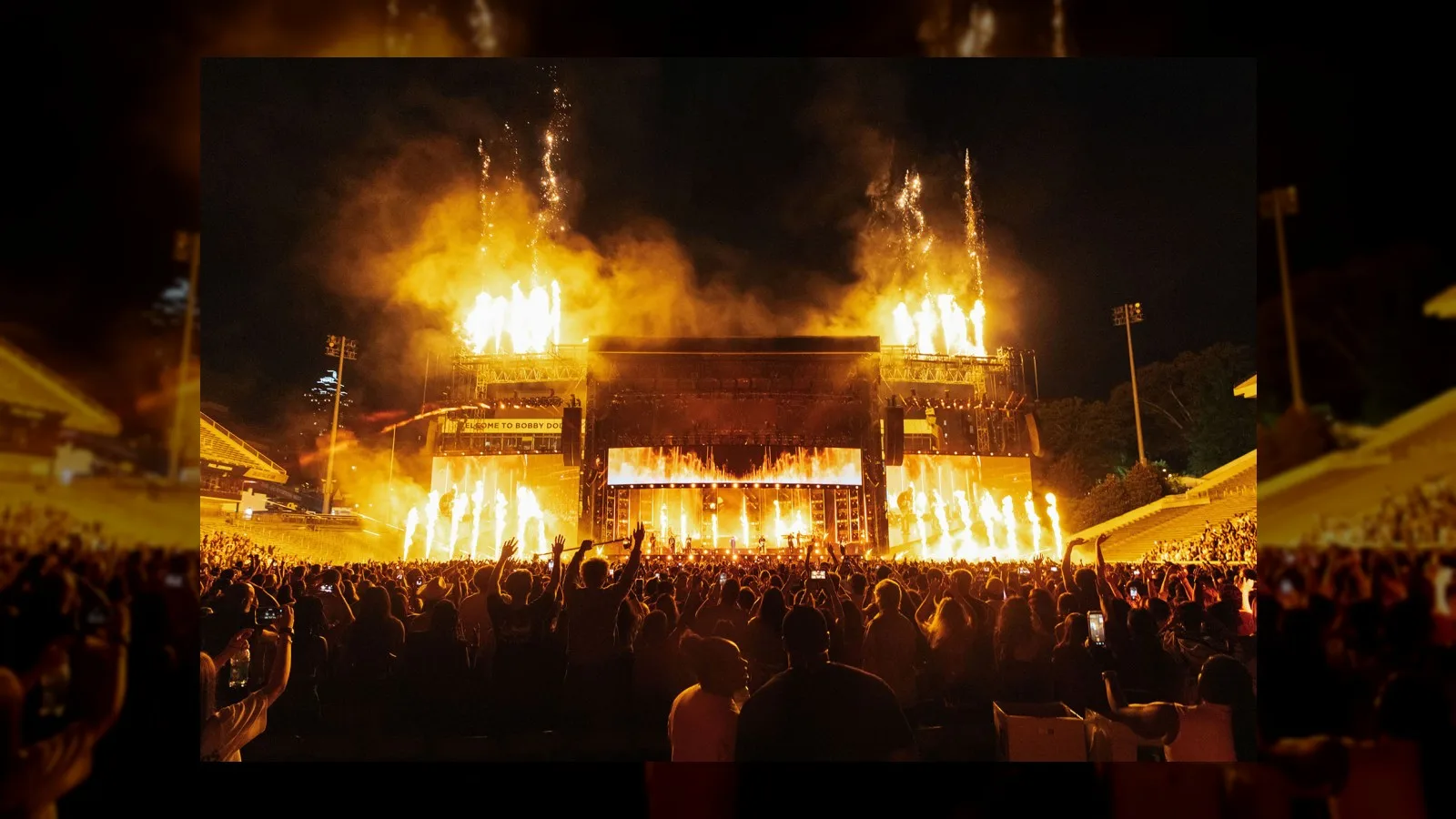
Bruno Mars’ The Romantic Tour ranks among the largest stadium runs of the year. Launched April 10 in Las Vegas, it began as a 39-date stadium tour, and demand has since pushed the count to 90 nights across North America, Europe and Japan, with the trek set to conclude Jan. 28, 2027, in Tokyo. Along the way, The Romantic Tour set the record for the highest first-day ticket sales ever for promoter Live Nation in North America, filling stadiums with tens of thousands of fans a night. Every one of those nights runs on the L-Acoustics L1 system, in its first tour deployment in the Americas.
L1 is the flagship of the L-Acoustics L Series and the most advanced expression to date of the company’s patented Progressive Ultra-Dense Line Source technology, engineered to deliver the power, bandwidth and pattern control that stadium productions demand.
Responsibility for putting that pre-launch system in the air night after night fell to Clair Global, the sound company behind the tour and an L-Acoustics L1 pilot partner. L-Acoustics unveiled L1, L1D and CS1 in May at its Keynote 2026 event at the Hollywood Bowl, yet the system had already been touring with Bruno Mars since April. Clair Global is one of a small group of partners entrusted with the system before its commercial release.
A stadium tour of this scale demands enormous output and even coverage. The L1 enclosures are large, but relative to the large-format systems they stand in for, a shorter L1 hang delivers comparable performance with fewer boxes and less weight flown overhead. The integrated cardioid design of L1 and CS1 keeps low-frequency energy on the audience and off the stage, giving Bruno Mars a cleaner space to perform in.
“It’s the first large-format cardioid system design from L-Acoustics, both the subwoofer and top box fully natively cardioid, and it’s been helping massively clean up stadium sound, which is always challenging,” said The Romantic Tour systems engineer Wayne Hall. “It just makes it sound more like a smaller, intimate venue, like a theater or a small arena, really, which has been quite amazing, considering the places we’re playing. It’s quite an accomplishment.”
For FOH engineer Sean “Sully” Sullivan, mixing the show night after night for stadium-sized audiences, the difference is immediate. “This system makes a stadium sound a lot smaller than it is,” he said. “Controlling the low end with a full cardioid PA pretty much eliminates the usual stuff rolling around these giant spaces. Once you add the finest mids and highs I’ve ever heard, the room just disappears.”
The gains hold up where stadium sound is hardest to control. “I found the new CS1 to be extremely impressive in the far field, which is traditionally where you’d lose low frequency at the top of the stadiums,” Hall said. “And we’re getting a seamless transition from the ground subs to the flown subs. As a result, we’re able to bring that ‘ground-floor experience’ up there that people are paying a premium for downstairs, so it feels like you’re giving even more back with this new product.”
That control marks an evolution in how the team deploys low end. “We’d been using KS28 in a cardioid configuration,” Sullivan said, “but having a box like CS1 that you don’t have to decide or configure just makes it easier and simpler. And this entire system has horsepower for days. Nothing comes close to the capabilities of L1 and CS1.”
Coverage consistency is central to how the L1 system performs in a stadium. Working within L-Acoustics Soundvision, the new-generation Autofilter algorithm shapes the low-frequency behavior of each L1 array, holding tonal balance steady from the front rows to the rear bowl.
“The boxes are quite large, but the way they’re designed and built means you can walk the room and hear a consistent effect,” Hall said. “You just hear the whole array as one single source, so you no longer get interactions between different boxes. It’s a smoother coverage front-to-back and you don’t really notice any tonal shift or change, along with the use of L-Acoustics’ Autofilter, which they’ve considerably improved to use with this new product. Overall, it’s just a much, much better sonic experience in terms of sound quality and SPL.”
For The Romantic Tour, the main arrays comprise five L-Acoustics L1 over one L1D per side, backed by 10 CS1 flown subs per side. Matching side-fill arrays of five L1 over one L1D per side are joined by 270-degree fill hangs of 12 K2 per side. Ground subs comprise 30 KS28 across the stage face in 10 cardioid-mode groups of three. Front-fills are 10 A10, each topping a sub cluster for spatialized front-fill, with four A15 serving as ground-level near out-fills. Delays are four arrays of 12 K2 each, addressing the rear-bowl seats. LA7.16 amplified controllers drive the L1, L1D, CS1 and K2 arrays, while LA12X drive the ground subs, front-fills and near out-fills.
For engineers who joined the production on short notice, the system proved quick to master. “I’d never seen this PA until we hit Vegas for the first show, yet I managed to work it out in pretty minimal time,” Hall said. “That’s a pretty good ‘kudos’ to them as a manufacturer, because if, without any training, you can make it work, that’s pretty good-going.” Sullivan finds the same familiarity: “L1 is very K1-like as far as capabilities and sonics; it has the familiar sound, and the workflow is very similar to what we were used to with K1 and K2 in the past.”
On this tour, Sullivan is also working with Source Intelligence, the L-Acoustics real-time vocal enhancement platform introduced alongside L1 and CS1. Running on the L-ISA Processor II, it uses machine learning to separate the lead vocal from crowd noise, instrument bleed, PA spill and room reflections, leaving a clean vocal for the engineer to work with.
“Bruno’s usually pretty far from the microphone, typically about six to eight inches away, and then there’s times where he’s two feet from the microphone, which can be a real challenge with loud side-fills and a big band,” Sullivan said. “Source Intelligence is really helping deal with keeping it clean and allowing me to do his compression as I like, as well as effects and dynamics. If the snare drum’s loud and bleeding into the vocal, it’s kind of hard to lay into it, but Source Intelligence takes care of that. In fact, you can’t even tell there’s any noise up there at all. Source Intelligence is so good at cleaning the junk out and leaving the vocal untouched. It’s all Bruno. And that’s what everyone came to hear.”
The Romantic Tour’s European dates began June 18 in Paris and continue through July 28 in London. The next North American leg runs from Aug. 21 in East Rutherford, New Jersey, through Oct. 21 in Vancouver, with additional shows in September and October across multiple cities. Special guest Anderson .Paak also performs as DJ Pee.Wee at every concert on the global tour.
For more information, visit l-acoustics.com.